
So the whole legal case for rent control in this state rests on a number — and here is the uncomfortable truth every rental housing provider eventually discovers: almost nobody can tell you how that number is actually calculated. The standards are vague, the methodologies vary by jurisdiction, the hearings are rare, and the cities administering this constitutional obligation often struggle to articulate it themselves. Owners are guaranteed a fair return the way travelers are guaranteed a fair exchange rate in an airport with no posted board: the right exists; the math is somebody else’s secret.
Until now. Santa Barbara — a city currently finalizing one of the strictest rent formulas any California city has proposed — published its fair-return methodology in its draft ordinance. And our team built the SBRSO Fair Return Calculator¹: a free tool that runs a city’s own fair-return arithmetic, step by step, on any owner’s real numbers. It is, as far as we can find, the first of its kind in California — and even if your buildings are hundreds of miles from Santa Barbara, ten minutes inside it will teach you more about how your own city’s version of this machinery works than most owners learn in a decade.
This article premieres the calculator, walks through the experiment it was built for, and shares what a year of documenting Santa Barbara’s council — verbatim, at SBRSO.com — reveals about the mindset and the narratives that produce ordinances like this one.
The calculator, first
Most California cities with rent control use the same test for fair return. It is called maintenance of net operating income — MNOI — and the idea is simple: you are entitled to keep earning what your building earned in a set base year, adjusted upward each year by a slice of inflation. If the capped rents leave you below that line, you have a shortfall — and grounds to petition for an increase above the cap. Santa Barbara’s draft ordinance (SBMC Chapter 26.90, section 26.90.050) uses exactly this test, with 2025 as the base year.
The SBRSO Fair Return Calculator follows that section of the ordinance step by step. You enter your building’s base-year income and expenses and its current picture; it walks the ordinance’s own math — what counts as income, which expenses count, how the inflation adjustment compounds — and shows you whether you have a shortfall, and how big, per unit. Every step is visible. Nothing is a black box. It’s free, there is nothing to sign up for, and it tells you the truth either way: plenty of buildings show no shortfall at all, and when that’s the answer, that’s the answer you get.
Why does this matter to anyone outside Santa Barbara? Three reasons.
It turns “fair return” into a number. Not a phrase in a court opinion — a figure you can compute, stress-test, and keep records toward. Owners who can see the math keep better books, and owners with better books get better outcomes: in petitions, in refinances, in sales.
It shows you the base-year trap before you fall in it. Under MNOI, one year of your books becomes your permanent baseline. Most owners learn this after it is too late to fix the books. Ten minutes in the calculator teaches it while there is still time. (Santa Barbara’s version is unusually aggressive — more below.)
It proves the math can be public. If a brokerage-funded research site can turn a city’s fair-return rules into a working calculator, cities can too. A right you cannot see calculated is barely a right at all — worth pressing wherever the next ordinance gets drafted.
The experiment it was built for
Santa Barbara’s draft caps annual increases at sixty percent of the change in California CPI, or three percent, whichever is lower — once per 12 months, with no banking. Computed from the April 2026 California CPI figure of 3.6 percent (the measurement the draft itself uses), here is what one year allows under that formula and its neighbors:
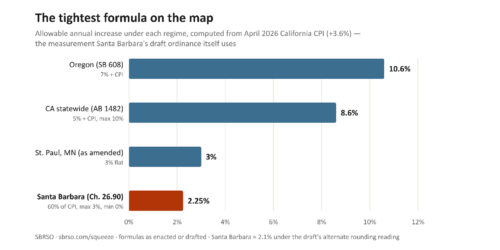
Sub-CPI fractions have precedent — San Francisco allows sixty percent of CPI, and Berkeley and Santa Monica run their own fractions that can produce comparably low numbers in a given year. What makes Santa Barbara’s draft an experiment worth statewide attention is everything piled on top of the fraction:
A hard three percent ceiling on top of the fraction. Back-tested against history, the ceiling binds exactly when owners need relief most: in 2022, when California CPI ran 7.7 percent, this formula would have allowed 3 percent
No banking. An increase not taken in a given year is gone. Owners who moderate rents for a long-tenured resident — the behavior every rent stabilization ordinance claims to encourage — permanently forfeit the difference. The formula teaches owners to take the maximum every year, whether they need it or not.
A zero percent floor with a frozen starting line. The base rent for every covered unit is the rent actually being paid on December 16, 2025 — a date selected before any ordinance existed, enforced by a temporary moratorium that has held increases at zero since February 26, 2026.
Coverage that reaches small properties. Certificates of occupancy before February 1, 1995 — roughly 13,000 units — including older duplexes as drafted. At the July 28 session, the council’s straw votes went further, striking the owner-occupied duplex exemption and directing that exemptions narrow to what state law requires. If that holds, a retiree renting out the other half of her duplex is regulated like a REIT.
The stakes outside Santa Barbara are simple: once a below-market formula becomes settled law in one city, it stops being a radical proposal everywhere else. It becomes the precedent in the next city’s staff report, the “Santa Barbara model” a councilmember cites three counties away. Sixty percent written here is the opening number somewhere else — which is why the details of how it got written matter.
How the number got written: the council’s own words
Every ordinance has an origin story, and Santa Barbara’s is unusually well documented — because SBRSO’s Council Record² preserved every substantive council statement verbatim, timestamped and deep-linked to the official meeting video. The record shows you, in the council’s own words, how a city talks itself into a formula like this.
When the council selected sixty percent on April 7, 2026 — a 4–3 vote — Councilmember Wendy Santamaria explained the majority’s logic, verbatim³:
“And the reason for 60% of CPI is that CPI in itself 40% of that is already housing. And so we don’t want to count housing twice. And that is what we would be doing if we put it at 100% of CPI. … We talk a lot about the Santa Barbara way and it needs to be tailored more to our living expenses.”
— Councilmember Wendy Santamaria
Housing does make up about 40 percent of how CPI is weighted. But that is not the same as housing driving 40 percent of any given year’s inflation — and nobody raised that distinction at the dais. The more revealing statement came from Councilmember Kristen Sneddon — a supporter of the ordinance — describing, at the same meeting4, how the number entered the draft at all:
“I knew that the 60% was the lowest number that was legally defensible from the research and … fully expected that that number would be negotiated upward … but something had to go in there as a placeholder.”
— Councilmember Kristen Sneddon
The placeholder was never negotiated upward. The lowest figure the council’s own research considered legally defensible went into the June 2026 public-review draft5 unchanged, survived a 655-comment public review, and was restated as settled at the July 28 session. Not the output of an economic study — an opening position no one ever moved. The entire quote record is public6, filterable by speaker and meeting, if you want to check any of this against the source.
The base year gets set before the game starts
The lesson other cities will copy from Santa Barbara is about timing — and it connects straight back to the calculator.
Conventionally, a city adopts an ordinance and rents float until the effective date. Santa Barbara inverted this: the council picked its base-rent date first (December 16, 2025), froze rents at that level by ordinance within weeks, and only then began the year-long process of writing the permanent program, targeted to begin January 1, 2027.
Why it matters: under MNOI, the base year is the constitutional baseline. As Assistant City Attorney Dan Hentschke explained at the June 9 hearing, verbatim7:
“The presumption is that whatever the landlord was charging … on the base rent was a fair return at the time because there was no restriction on that rent. So that was market rent at the time and whatever net operating income they were receiving from the operation that was a fair return to them.”
— Assistant City Attorney Dan Hentschke
One premise here deserves scrutiny: ‘no restriction on that rent’ is not accurate. Since January 2020, state law, the Tenant Protection Act (AB 1482), has capped increases on most of these rentals at CPI plus 5%, never more than 10%. For any long-standing tenancy, the December 16, 2025 rent was not an unrestricted market rent. It was an already-capped rent — which the city has now frozen and declared the owner’s ‘fair return’ baseline.
The city presumes each owner’s 2025 income was a fair return — and every future petition is measured against it. So if your 2025 books understate how the building really performed — a courtesy discount you never wrote down, expenses run informally through family, income that never hit a clean statement — the return you are legally entitled to maintain just shrank with them. And it happened before most owners knew a game was on. Run your own numbers through the calculator8and you will see exactly which base-year line items drive the answer. That is the point of publishing the math.
What the cost record shows
The argument for the formula is affordability, and the burden on Santa Barbara renters is real. The question a cap has to answer is different: can the buildings live on it?
We pulled the public cost record for a typical pre-1995 Santa Barbara building — property tax under Proposition 13, insurance rate filings, City utility schedules, CPUC tariffs, federal labor and materials indices — weighted each cost the way a real operating budget does, and tracked the total from a 2016 starting line. The result is The Cost Squeeze9, where every series is downloadable and the deliberately conservative methodology is published:
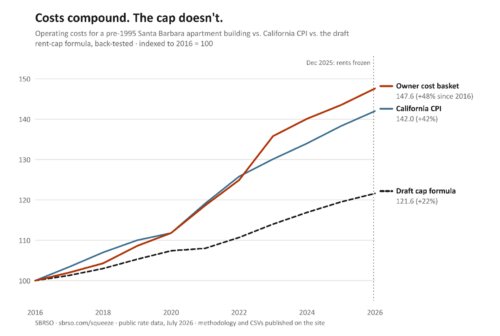
Three numbers carry the story. Owner operating costs are up roughly 48 percent since 2016. California CPI over the same decade: about 42 percent. The proposed formula, back-tested over that same decade, would have allowed cumulative increases of about 22 percent — less than half of documented cost growth, with insurance up roughly 90 percent and electricity more than doubled. That gap does not close; it compounds. The first annual adjustment under the program — approximately 2.1 percent, from April 2026 CPI — arrives January 1, 2027, applied to rents flat since December 2025. The fair-return petition is the ordinance’s only answer to that arithmetic — which is exactly why the petition math deserves a public calculator.
What it does to values — and what the research says happens next
The council has a theory about what a capped income stream does to an owner’s investment: not much. Councilmember Kristen Sneddon put it directly at the December 16 policy-direction session, describing a building she grew up in, verbatim10:
“…it’s still profitable, increased in value because it’s a constrained market. And where the wealth generated in this property comes from is not from the rents. It’s from the increased value of the property just by existing over time.”
— Councilmember Kristen Sneddon
That is the theory in one sentence: values rise “just by existing,” so capping the rents does no real harm to the owner. It is also exactly backwards from how these buildings are actually bought, sold, and financed. Apartment buildings are valued on income. When allowable income growth drops to roughly two percent a year while expenses grow at several times that, buyers reprice the risk — and in Santa Barbara they already have. Buyers now underwrite covered buildings on the rents actually in place, not the rents a renovation might someday justify. And the market splits: two buildings a block apart now trade on different math, depending on which side of the 1995 line — or the city line — they sit.
A building’s price is what its income can support. When the law caps the income, the “increased value just by existing” quietly stops existing too. The long-run supply effects have a literature. The most-cited modern study Diamond and McQuade’s Stanford analysis11of San Francisco’s 1994 rent control expansion — found affected owners reduced rental supply by about 15 percent, controlled stock fell roughly 25 percent over fifteen years, and the resulting scarcity pushed citywide market rents up over the long run. Santa Barbara’s council heard this research in public comment. The formula did not move. Mayor Randy Rowse, dissenting at the May 19 session12:
“I think it’s a train wreck both for landlords and tenants in the long run. … we’ve got a financial analysis of what it is from one side, but not from the other. … we’ve pretty much put a very chilled atmosphere out there in the business of being a landlord.”
— Mayor Randy Rowse
The record behind all of it
Everything in this article traces to SBRSO — the Santa Barbara Rent Stabilization Observatory13, the free research site our team built and maintained as the ordinance moved: the Fair Return Calculator14; a plain-English, section-by-section guide15to the draft and a status tracker updated at every milestone; The Cost Squeeze16 with downloadable CSVs; the Council Record17 — 87 verbatim quotes and counting; and The Honest Case18, a long-form essay that makes the strongest case for rent stabilization before testing it against the evidence.
The disclosure, stated plainly because it matters: SBRSO is funded by Radius Commercial Real Estate19, the Santa Barbara brokerage where I work, and I lead the project. We represent owners of multifamily property, including property this ordinance covers. That is precisely why the quotes are verbatim rather than paraphrased, the methodology is public, and the corrections policy20is real — the record has to stand on its own or it is worthless.
For providers elsewhere in California, the practical takeaway is twofold. Near term: spend ten minutes in the calculator21with your own numbers — the base-year lesson applies wherever MNOI does, and your city’s base year may get picked sooner than you think. Longer term: when a version of this ordinance reaches your city, the side with the cleanest record tends to win the argument. Santa Barbara’s record is free to study, and free to copy.
Where it stands now
As this article goes to press: rents in covered Santa Barbara units remain frozen at December 16, 2025 levels. On July 2822, the council reviewed roughly 655 public comments and straw-voted drafting direction across a 127-item amendment matrix — narrowing exemptions toward the state-law list, phasing a registry that will eventually cover all rental units (registration becomes a condition of lawfully collecting rent), making the rent board advisory, and retaining the MNOI fair-return standard. A revised ordinance is expected back in August, with adoption at a subsequent meeting and the program targeted to begin January 1, 2027. Whether that calendar holds, the record will show — in real time, at sbrso.com/ordinance, which sends one short email when something actually changes.
About the Author
Jack Gilbert leads SBRSO — the Santa Barbara Rent Stabilization Observatory — and is a multifamily investment advisor with the Golis Team at Radius Commercial Real Estate in Santa Barbara (DRE 02197493), alongside Steve Golis (DRE 00772218) and Aneta Jensen (DRE 01994822). Contact: jgilbert@radiusgroup.com • (805) 728-5561. Council quotes are verbatim from official City of Santa Barbara meeting video via SBRSO’s Council Record; regulatory details reflect the June 10, 2026 public-review draft of SBMC Chapter 26.90 and the council’s July 28, 2026 straw-vote direction, and remain subject to amendment and adoption. Nothing here is legal, tax, or appraisal advice; fair-return outcomes depend on jurisdiction-specific standards and individual facts.
1 https://sbrso.com/fair-return
2 https://sbrso.com/council-record
3 https://www.youtube.com/watch?v=33OWM8XMR2s
4 https://www.youtube.com/watch?v=33OWM8XMR2s
5 https://sbrso.com/ordinance
6 https://sbrso.com/council-record
7 https://www.youtube.com/watch?v=UqTaTlW6SRg
8 https://sbrso.com/fair-return
9 https://sbrso.com/squeeze
10 https://www.youtube.com/watch?v=UyOUAB3PZUE&t=21533s
11 https://www.gsb.stanford.edu/insights/rent-controls-winners-losers
12 https://www.youtube.com/watch?v=6Tc4fEYHXmY
13 https://sbrso.com
14 https://sbrso.com/fair-return
15 https://sbrso.com/ordinance
16 https://sbrso.com/squeeze
17 https://sbrso.com/council-record
18 https://sbrso.com/honest-case
19 https://www.radiusgroup.com
20 https://sbrso.com/about
21 https://sbrso.com/fair-return
22 https://www.youtube.com/watch?v=LLIZJ7qAuW4
Recent News
Santa Barbara City Council Gives Final Approval to Rent Control, 4–3
The Santa Barbara City Council gave final approval to the city’s rent control ordinance on a 4–3 vote at its Tuesday, October… Read more »
Noozhawk: Santa Barbara Council Candidates Discuss Housing Affordability, State Street
Not all Santa Barbara City Council candidates believe that the city shares any responsibility in the housing affordability crisis, a recent candidate forum… Read more »
KEYT: Top Stories: Santa Barbara City Council Candidates Address Housing, Development at Forum
Santa Barbara City Council candidates gathered at Cabrillo Pavilion Thursday to discuss some of the key issues facing the city, including …