
On July 28, the Santa Barbara City Council returned to its permanent rent stabilization ordinance — its first session on the subject since the public-comment window on the June 10 draft closed July 10. A temporary rent freeze has already been in force since February retroactive to December 16, 2025, and the permanent program is slated to begin in 2027. Together they will govern the income — and therefore the value — of roughly 13,000 multifamily units inside the city limits. If adopted as currently drafted and without legal intervention, here is what it means for owners, property managers and other stakeholders.
Where things stand. The July 28 agenda item called for the Council to receive staff summaries of the public comments on both the rent stabilization ordinance and the companion Just Cause / Ellis Act amendments. What it did not do is finish the job: under the City Charter, no ordinance may be adopted on the day it is introduced — or within five days of introduction — and most ordinances take effect 30 days after adoption. The final vote, any amendments, and the program’s actual start date therefore land at later meetings. The terms below describe the June 10 draft as written; for what happened on July 28 and every revision after it, see sbrso.com/ordinance.
If you own apartments anywhere on California’s Central Coast, this is the moment to understand the new math. This guide breaks down what has passed, what the draft would do, who is covered, and how rent control tends to move multifamily property values — followed by a practical action plan for owners across Santa Barbara, Ventura, and San Luis Obispo counties. It also introduces SBRSO — the Santa Barbara Rent Stabilization Observatory, the free research resource our team built so owners can follow all of it from one place.
The Two-Part Shift: A Rent Freeze Today, Permanent Rent Control in 2027
Santa Barbara is rolling out rent regulation in two stages — a stop-gap freeze now, and a permanent program beginning in 2027.
Stage 1 — The temporary rent freeze (in effect since February)
In January 2026, the Santa Barbara City Council voted 4–3 to adopt a Temporary Rent Increase Moratorium (Ordinance No. 2026-6206). The key terms:
● 0% increases. Rents on covered units are frozen at the amount in effect on December 16, 2025. No annual increase is permitted while the freeze is in place.
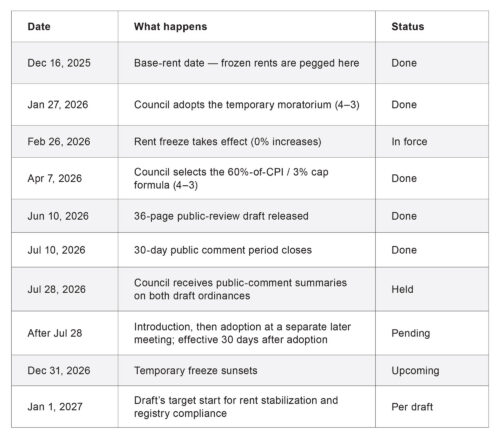
● Effective February 26, 2026 — and effectively retroactive to December 16, 2025. The City uses the rents actually being paid on that December date as each unit’s base rent and fair-return baseline, regardless of whether those rents were below, at, or above fair-market levels.
● Covered units: residential units with a certificate of occupancy issued before February 1, 1995 (generally, buildings built before 1995). Older duplexes are covered.
● Sunset: the freeze automatically expires December 31, 2026, or when the permanent ordinance becomes operative — whichever comes first.
● Eviction limits added at the same time: a no-fault “withdrawal from the market” must now remove all units at the property at once, with a five-year bar on re-renting them.
● Already tested in court. An owner group’s lawsuit challenging the temporary freeze was dismissed, and the group has signaled it may file an amended complaint — a reminder that the permanent ordinance’s final terms and timing are not the only open variables.
Stage 2 — The permanent ordinance (moving through Council; slated to begin in 2027)
The Council released a 36-page draft ordinance for public review on June 10, 2026, and set a 30-day comment period that closed July 10. Staff compiled that input into a summary of key themes and suggested revisions, which came back to the Council on July 28. The draft targets January 1, 2027 as the start of rent stabilization, but the real date follows adoption — an ordinance takes effect 30 days after the Council adopts it, so the calendar depends on when that vote lands. Reporting to date has put the program’s realistic start anywhere from early to late January 2027. The major features of the draft as it stands:
● Annual cap = the lesser of 60% of CPI or 3% — with a 0% floor if CPI is negative. This is a hard ceiling, not a target.
● One increase per 12-month period.
● No rent banking. Increases you don’t take in a given year are gone — you can’t save them up and apply them later.
● A mandatory rental registry. Owners must register addresses, unit counts, ownership/contact info, and current rents — even if the unit is exempt. Landlords who don’t register can’t legally collect rent or list a unit.
● An owner-funded program. Per-unit registration fees are projected to fund a program costing roughly $2 million a year.
● A new rent board of five to seven members — tenants, landlords, and neutral members — plus a program administrator.
● Petition processes for relief, including a “right to fair return” petition and a capital-improvement petition for owners; tenants can likewise petition for a downward adjustment.
● Exemptions generally aligned with state law: most single-family homes, condominiums, owner-occupied duplexes, and government-subsidized affordable housing.
Santa Barbara rent control timeline at a glance:
|
Who and What Is Covered — and What’s Exempt
This is the first question every owner should answer, because coverage determines almost everything that follows.
Covered (subject to the freeze now and the cap in 2027): Multifamily residential units in the City of Santa Barbara whose certificate of occupancy was issued (or final building-permit inspection completed) before February 1, 1995 — an estimated 13,000 units. Pre-1995 duplexes are included.
Generally exempt: new construction (certificate of occupancy on or after February 1, 1995); most single-family homes and condominiums that are separately sellable, consistent with the Costa-Hawkins Rental Housing Act — though under the draft that exemption is conditional: a single-family home or condo owned by a REIT, a corporation, or an LLC with a corporate member is covered, not exempt; owner-occupied duplexes; and deed-restricted / government-subsidized affordable housing.
One distinction owners repeatedly miss: this is a City of Santa Barbara ordinance. It does not apply in Goleta, Carpinteria, Montecito, the unincorporated county, or anywhere in Ventura or San Luis Obispo counties. Those markets remain governed primarily by California’s statewide Tenant Protection Act (AB 1482). Where your building sits relative to the city limit line now has a direct, measurable effect on how you can operate it.
How Santa Barbara’s Cap Compares to California State Law
It’s easy to hear “rent cap” and assume Santa Barbara is simply adopting the statewide standard. It is not — the local cap is far tighter.
Under AB 1482, most California rentals can rise by 5% plus regional CPI, up to a 10% maximum each year. For the Southern California / Central Coast CPI region, that has recently meant allowable increases in the 8–9% range.
Santa Barbara’s ordinance caps increases at 60% of CPI, with a 3% ceiling. Based on the most recently published California CPI figures, the first allowable increase in 2027 is on track to land at roughly 2 to 2.25 percent (the exact figure depends on how the City applies the ordinance’s rounding step) — and it can never exceed 3%. In practical terms, Santa Barbara’s annual cap is roughly one-quarter to one-third of what state law would otherwise allow. And the ceiling binds hardest exactly when owners need relief most: back-testing the formula against history, even in 2023 — when California CPI ran 7.7% — the cap would have permitted just 3%.
How the council landed on 60% — in their own words
It’s worth hearing the reasoning directly. Every council quote below is verbatim from official meeting video, via SBRSO’s Council Record. Making the motion to set the cap at the April 7 meeting, Councilmember Wendy Santamaria explained the majority’s logic:
“And the reason for 60% of CPI is that CPI in itself 40% of that is already housing. And so we don’t want to count housing twice. And that is what we would be doing if we put it at 100% of CPI. … We talk a lot about the Santa Barbara way and it needs to be tailored more to our living expenses.”
— Councilmember Wendy Santamaria, City Council meeting, April 7, 2026 (verbatim, public record)
At the same meeting, Councilmember Kristen Sneddon — a supporter of the ordinance — described how the 60% figure had entered the draft in the first place:
“I knew that the 60% was the lowest number that was legally defensible from the research and … fully expected that that number would be negotiated upward … but something had to go in there as a placeholder.”
— Councilmember Kristen Sneddon, City Council meeting, April 7, 2026 (verbatim, public record)
The placeholder was never negotiated upward. The lowest number the council’s own research considered legally defensible is the formula that carried into the July 28 meeting.
“I’ve watched the Central Coast multifamily market through several interest-rate cycles since 1979, and the biggest driver of an apartment building’s value has always been the freedom to bring rents to market. Santa Barbara’s ordinance narrows that freedom to roughly two percent a year. That doesn’t make these buildings bad investments — it makes them different investments, and the owners who understand the new math first are the ones who will protect their equity.”
— Steve Golis, Principal & Founder, Radius Commercial Real Estate (DRE 00772218)
How Rent Control Affects Multifamily Property Values
Apartment buildings are valued on their net operating income (NOI): roughly, Value = NOI ÷ Cap Rate. Rent control puts pressure on both sides of that equation. Here is how the value impact actually works.
1. Slower income growth, repriced at a higher cap rate
When allowable rent growth drops from “market” to roughly 2% a year, future NOI growth slows — while expenses do not. The expense side is not hypothetical. Tracking the operating costs of a typical pre-1995 Santa Barbara building, SBRSO’s cost data shows insurance premiums up ~90% and electricity more than doubled since 2016 — against a rent cap that would have allowed cumulative increases of barely 2% a year over the same period. When income is capped but expenses aren’t, buyers price in that risk by demanding a higher cap rate on covered assets — which, on the same NOI, means a lower price.
2. The value-add playbook narrows
For more than a decade, the dominant strategy for Santa Barbara’s aging apartment stock was value-add: acquire a tired 1970s or 1980s building, renovate, and reset rents to market on turnover. A 60%-of-CPI cap with no banking sharply limits the rent reset that made those deals work on covered units.
“For the last decade, value-add was the playbook in Santa Barbara — buy an older building, renovate, and bring rents to market. A cap near two percent with no banking takes most of that lever away on covered units. Buyers are now underwriting in-place income instead of pro-forma rents, and that repricing is already showing up in what people will pay per door. The properties that hold value best are the ones with clean, well-documented financials — if you can prove your base-year NOI, you protect both your fair-return rights and your eventual sale price.”
— Jack Gilbert, Multifamily Investments, Radius Commercial Real Estate
3. A bifurcated market: covered vs. exempt
Expect values to split. Exempt product — post-1995 construction, condos, single-family rentals, and buildings outside the city limit — becomes more desirable precisely because it retains pricing flexibility, and can command premium pricing. Covered product faces the opposite pressure. Two buildings a block apart can now trade at meaningfully different cap rates based solely on which side of the 1995 line — or the city line — they fall on.
4. Financing follows income
Lenders size loans to sustainable, in-place income and conservative growth assumptions. A capped growth profile plus new compliance costs can mean lower loan proceeds and more conservative underwriting on covered assets — another factor that flows through to value.
Even the dais has heard the warning
None of this is only the brokerage community talking. Casting the lone dissent at the council’s May 19 session, Mayor Randy Rowse put the long-run risk bluntly:
“I think it’s a train wreck both for landlords and tenants in the long run. … we’ve got a financial analysis of what it is from one side, but not from the other. … we’ve pretty much put a very chilled atmosphere out there in the business of being a landlord.”
— Mayor Randy Rowse, City Council meeting, May 19, 2026 (verbatim, public record)
What the research says about rent control over the long run
This isn’t only theory. The most-cited modern study of rent control — Stanford economists Rebecca Diamond and Tim McQuade’s analysis of San Francisco’s 1994 expansion — found that landlords subject to rent control reduced rental housing supply by about 15% by converting or redeveloping buildings and selling to owner-occupants. Rent-controlled units fell 25% between 1994 and 2010. The policy delivered real savings to tenants already in place, but the lost supply pushed up market rents citywide over the long run. The lesson for owners: regulation reliably changes owner behavior, and the value effects show up in supply, maintenance, and transaction patterns — not just in the rent roll.
SBRSO.com: The Free Resource We Built to Track All of It
All spring, our team fielded the same questions from owners, week after week: Is my building covered? What can I actually raise? What did the council actually say? What is my property worth under this? The public debate was running on slogans — from both sides — while the answers sat scattered across a 36-page draft ordinance, months of council meetings, and a dozen public data sources.
So we built the missing resource: SBRSO — the Santa Barbara Rent Stabilization Observatory, at sbrso.com. The name is deliberate. It’s an observatory, not an advocacy shop: it watches, measures, and documents, with every claim cited to a public source. It’s free, there’s no paywall or registration, and we keep it current as the ordinance moves. The questions owners raised at our July 8 Rent Control Roundtable shaped much of what’s on it. What you’ll find there:
● The Squeeze — the site’s signature chart, tracking a typical pre-1995 building’s operating-cost basket against California CPI and against the ordinance’s cap formula, all from public rate data. The headline finding: since 2016, owner operating costs are up roughly 48%, while the proposed cap formula would have allowed cumulative increases of about 22% — costs have grown at more than twice the pace the cap would permit.
● The Ordinance, Explained — a plain-English, section-by-section guide to the June 10 draft, a timeline of every council action, and documentation of drafting errors in the current text.
● The Council Record — verbatim, timestamped quotes from council members, staff, and public comment, each paired with an analytical note that tests the claim against the data. No paraphrasing, no spin — the record as it exists.
● The Fair Return Calculator — a free tool that walks a covered owner through the ordinance’s own “maintenance of net operating income” math to estimate whether your numbers could support a petition above the cap.
● The Honest Case — a long-form essay that makes the strongest case for rent stabilization before examining, on the evidence, why this mechanism tends to fail renters and owners alike — and what would actually help.
If you own — or are thinking about buying or selling — covered property in Santa Barbara, bookmark it. It exists so that every owner, reporter, and council member is at least arguing from the same facts.
What This Means for Owners Across Santa Barbara, Ventura & SLO Counties
Because Santa Barbara’s ordinance is a city-limits program, it is creating a patchwork that rewards owners who understand the map.
● Inside the City of Santa Barbara: Covered owners should plan around a ~2% growth ceiling, registry compliance, and a more income-driven valuation. Exempt owners (newer product, condos, SFRs) hold a relative advantage.
● Goleta, Carpinteria & unincorporated Santa Barbara County: Not subject to the city ordinance; state law (AB 1482) governs, with materially more rent flexibility.
● Ventura and San Luis Obispo counties: Likewise governed primarily by state law today — one reason investor attention is broadening across the region.
“We’re already fielding two kinds of calls: Santa Barbara owners asking what their building is worth today versus a year from now, and investors who want multifamily exposure but outside the city’s jurisdiction. Capital is rotating toward exempt product and toward Ventura and San Luis Obispo counties, where the rules are still mainly set by the state. Knowing which side of a city line your building sits on has never mattered more to its value.”
— Aneta Jensen, Multifamily Investments, Radius Commercial Real Estate (DRE 01994822)
A Santa Barbara Landlord’s Action Plan Before January 2027
The owners who fare best under rent control are rarely the ones who fight it hardest — they’re the ones who prepared early. Six concrete steps:
1. Confirm your coverage. Pull each property’s certificate-of-occupancy date and unit type. Pre-Feb 1995, non-exempt units in the city are covered; everything else may not be. SBRSO’s ordinance guide walks through the coverage rules in plain English.
2. Document your base-year NOI now. The fair-return petition — and your eventual sale price — both depend on clean, defensible income and expense records. Get your books audit-ready before 2027.
3. Understand the fair-return petition. California’s Constitution guarantees owners a fair return, and the draft includes a petition to seek an increase above the cap when your numbers justify it. It’s a real safety valve — but it is used and granted sparingly, so documentation quality matters enormously. Run your building’s numbers through the free SBRSO Fair Return Calculator to see where you stand.
4. Map the capital-improvement path. The draft allows a separate petition to recover qualifying capital improvements (subject to limits). If major work is on your horizon, timing and structure now affect what you can recover later.
5. Reassess hold vs. sell — with current numbers. For some owners the right move is to hold income-stable assets; for others, repositioning ahead of 2027 — including a 1031 exchange into exempt product or into Ventura/SLO markets — better protects long-term returns.
6. Get a current Broker Opinion of Value. Values are repricing in real time. Knowing what your building is worth today, under the new framework, is the foundation for every other decision. You can request a confidential valuation in about two minutes.
One more reason steps 2 and 3 deserve priority: under the draft’s fair-return math, your 2025 books are the baseline. As Assistant City Attorney Dan Hentschke explained at the June 9 hearing:
“The presumption is that whatever the landlord was charging … on the base rent was a fair return at the time because there was no restriction on that rent. So that was market rent at the time and whatever net operating income they were receiving from the operation that was a fair return to them.”
— Assistant City Attorney Dan Hentschke, City Council meeting, June 9, 2026 (verbatim, public record)
Translation: the City presumes your December 2025 net operating income was a fair return — and any future petition for relief is measured against it. If your 2025 records understate your true position (undocumented income, missing expense records, informal related-party arrangements), they quietly shrink the return you’re entitled to maintain. Clean books aren’t just good hygiene; they’re your constitutional baseline.
How the Golis Team Can Help
The Golis Team at Radius Commercial Real Estate is one of the Central Coast’s most active multifamily brokerage groups, with deep roots from Ventura through Santa Barbara to San Luis Obispo County. Multifamily isn’t a sideline for us — it’s our specialty, and building SBRSO is part of how we practice it. We’re helping owners navigate exactly this transition:
● Current valuations and Broker Opinions of Value that reflect the new regulatory reality, not last year’s comps — start with a confidential valuation request.
● Fair-return and base-year NOI modeling so you understand the real income ceiling on your asset — and the case you could make for relief.
● Hold/sell and 1031 strategy across covered, exempt, and out-of-jurisdiction product.
● Off-market and on-market execution backed by decades of Central Coast multifamily transactions.
Reach the team directly: Steve Golis (Principal & Founder) · Jack Gilbert (Multifamily Investments) · Aneta Jensen (Multifamily Investments).
If you own apartments anywhere from Ventura to SLO and want to know how the rent freeze and the 2027 ordinance affect your building’s value, contact the Golis Team for a confidential, no-obligation consultation.
Frequently Asked Questions
When does Santa Barbara rent control start?
A temporary rent freeze has been in effect since February 26, 2026, holding covered rents at their December 16, 2025 level. The permanent ordinance was still working through the Council process as this article went to press: the Council took up staff’s public-comment summaries on July 28, 2026, and under the City Charter adoption must occur at a later meeting, with the ordinance taking effect 30 days after that vote. The draft targets a January 1, 2027 start. Confirm where it stands at sbrso.com/ordinance.
How much can I raise rent in Santa Barbara in 2026 and 2027?
For covered units, the answer in 2026 is 0% — rents are frozen. Beginning in 2027, the annual increase is capped at the lesser of 60% of CPI or 3%, with no banking of unused increases. Based on current CPI data, the first 2027 increase is on track to land at roughly 2 to 2.25 percent.
Is my building covered by Santa Barbara rent control?
Generally, multifamily units in the City of Santa Barbara with a certificate of occupancy issued before February 1, 1995 are covered (including pre-1995 duplexes). Most single-family homes, condos, owner-occupied duplexes, newer construction, and subsidized affordable housing are exempt — though a single-family home or condo owned by a REIT, corporation, or LLC with a corporate member is covered under the draft. Properties outside the city limits are not subject to the ordinance.
Does rent control apply in Goleta, Carpinteria, Ventura, or San Luis Obispo?
No. The ordinance applies only within the City of Santa Barbara. Other Central Coast jurisdictions are governed primarily by California’s statewide Tenant Protection Act (AB 1482), which currently allows larger annual increases (5% + CPI, up to 10%).
What is the “fair return” petition?
It’s a process — rooted in California’s constitutional guarantee that owners may earn a fair return — that lets an owner petition for an increase above the standard cap when documented income and expenses justify it. The draft includes such a petition, plus a separate capital-improvement petition. Strong financial records are essential to a successful filing. The free SBRSO Fair Return Calculator walks through the math.
Where can I read the ordinance and track what happens next?
SBRSO.com — the Santa Barbara Rent Stabilization Observatory — maintains a plain-English guide to the draft ordinance, a timeline of every council action, a verbatim council record, cost data, and a fair-return calculator, all free and fully sourced. The City’s official rent stabilization page is at santabarbaraca.gov.
Will rent control lower my property’s value?
For covered assets, rent control tends to slow income growth and raise the cap rate buyers require, which puts downward pressure on value — while exempt and out-of-jurisdiction properties often hold or gain relative value. The size of the effect depends on your building’s age, location, current rents versus market, and financing. A current Broker Opinion of Value is the only reliable way to know where your specific asset stands.l, connect confidentially with Kathleen for more details and introductions to local professionals, or contact your REALTOR®.
Written by the Golis Team at Radius Commercial Real Estate — multifamily investment advisors serving Santa Barbara, Ventura, and San Luis Obispo counties, and the team behind SBRSO.com. Regulatory details reflect the City of Santa Barbara’s June 10, 2026 public-review draft ordinance, which remained subject to Council amendment and adoption as this article went to press.
Recent News
Santa Barbara City Council Gives Final Approval to Rent Control, 4–3
The Santa Barbara City Council gave final approval to the city’s rent control ordinance on a 4–3 vote at its Tuesday, October… Read more »
Noozhawk: Santa Barbara Council Candidates Discuss Housing Affordability, State Street
Not all Santa Barbara City Council candidates believe that the city shares any responsibility in the housing affordability crisis, a recent candidate forum… Read more »
KEYT: Top Stories: Santa Barbara City Council Candidates Address Housing, Development at Forum
Santa Barbara City Council candidates gathered at Cabrillo Pavilion Thursday to discuss some of the key issues facing the city, including …